
 3 of 3
This third white paper in the series on Software Defined (SD) technologies aims to cover in more detail some of the technical terms used, what these actually mean, the concepts they cover and how they fit together in the SD landscape.
Get white paper In partnership with%20(1).png)

This third white paper in the series on Software Defined (SD) technologies aims to cover the technical terms used in SD-WAN, what they mean and how they fit together. We will also look at how the Primary SDN Components contribute to the efficiencies and benefits of utilising SD technologies.
Download our White Paper to discover in-depth insight into SD-WAN technical concepts.
We will see exactly how vSmart, vEdge, vBond and vManage interlink and how the services used to manage these components and systems contribute to the efficiencies and benefits of utilising SD technologies.
Each domain is identified by a unique integer, called the domain ID. Currently, you can configure only one domain in an SD-WAN overlay network.
Within a domain, vEdge routers can connect only with the vSmart controllers in their own domain. The vBond orchestrator is aware of which vSmart controllers are in which domain, so that when new vEdge routers come up, the vBond orchestrator can point those routers to the vSmart controllers in the proper domain. However, the vBond orchestrator is never a member of a domain.
Within a domain there is full synchronization of routing information among the vSmart controllers and vEdge routers, and there is scope for route aggregation and summarization. An organization can divide up its network into domains to serve desired business purposes. For example, domains can correspond to a large geographic area or to data centers so that each data center and the branches for which it is responsible are contained within a single domain.
Download our White Paper to discover in-depth insight into SD-WAN technical concepts.
This address is similar to the router ID on a regular router. The system IP address provides permanent network overlay addresses for vEdge routers and vSmart controllers, and allows the physical interfaces to be renumbered as needed without affecting the reachability of the SD-WAN device. You write the system IP address as you would an IPv4 address, in decimal four-part dotted notation.
A TLOC identifies the physical interface where a vEdge router connects to the WAN transport network or to a NAT gateway. A TLOC is identified by a number of properties, the primary of which is an IP address–colour pair.
In the APIC GUI a VRF is also called a ‘context’ or ‘private network’
SD-WAN uses a centralised controller for easy orchestration, with full intent based policy control that includes granular access control and a scalable secure data plane between all edge nodes. SD-WAN allows edge nodes to communicate directly over any type of transport network, consumer grade public internet connectivity, business grade public internet connectivity metro Ethernet, MPLS or LTE.
OMP is the protocol responsible for establishing and maintaining the SD-WAN control plane, as such it provides the following services:
The SD-WAN control plane architecture uses three types of OMP routes:
Download our White Paper to discover in-depth insight into SD-WAN technical concepts.
Each site is identified by a unique integer, called a site ID. Each SD-WAN device at a site is identified by the same site ID. So within a data center, all the vSmart controllers and any vEdge routers are configured with the same site ID. A branch office or local site typically has a single vEdge router, but if a second one is present for redundancy, both routers are configured with the same site ID.
The SD-WAN implementation of data plane authentication and encryption establishes security associations between each pair of devices that want to exchange data, but it dispenses with Internet Key Exchange (IKE) altogether. Instead, to provide a scalable solution to data plane key exchange, the SD-WAN takes advantage of the fact that the Datagram Transport Layer Security (DTLS) control plane connections in the SD-WAN overlay network are known to be secure. Because the SD-WAN control plane establishes authenticated, encrypted, and tamperproof connections, there is no need in the data plane to set up secure communications channels to perform data plane authentication.
In the SD-WAN network, data plane encryption and key generation are done by AES-256, a symmetric-key algorithm that uses the same key to encrypt outgoing packets and to decrypt incoming packets. Each vEdge router periodically generates an AES key for its data path (specifically, one key per TLOC) and transmits this key to the vSmart controller in OMP route packets, which are similar to IP route updates. These packets contain information that the vSmart controller uses to determine the network topology, including the vEdge router’s TLOC and AES key. The vSmart controller then places these OMP route packets into reachability advertisements that it sends to the other vEdge routers in the network. In this way, the AES keys for all the vEdge routers are distributed across the network. Even though the key exchange is symmetric, SD-WAN devices use it in an asymmetric fashion. The result is a simple and scalable key exchange process that does not use per-pair keys.
Usually these devices are associated with a physical appliance and are hosted in a resilient pair on each site, the inherent costs of doing so can escalate the per site budget of a branch WAN deployment.
To use service chaining, a resilient pair of virtualised (can be physical, if required) service appliances are provisioned in a centralised public or private cloud instance. Traffic is then seamlessly redirected from a TLOC by a per-VPN service chaining policy to the relevant service appliance. This action allows the service appliance to inspect or load balance the traffic before sending it on to the destination TLOC. The service chaining policy is pushed to the TLOC using OMP from the vSmart. When a service chaining policy requires the traffic to be rerouted to a service, the policy on the vSmart controller changes the next hop for the OMP routes to the service landing point. In this way, the traffic is first processed by the service before being routed to its final destination.
The service chaining policy can reference multiple virtual services appliances, and in combination with orchestration and cloud management technologies, can provision a new firewall service. So, for example if a firewall site exceeds its capacity, it can automatically add a new service to the service chaining policy with a more preferential weighting if required. Similarly, services can be deployed as part of an orchestration workflow, whereby the VPN and service chaining policies use an API to build both the SD-WAN and services layer as part of a single automated provision.
Here are some examples of use cases for rerouting a traffic flow through a service or chain of services:
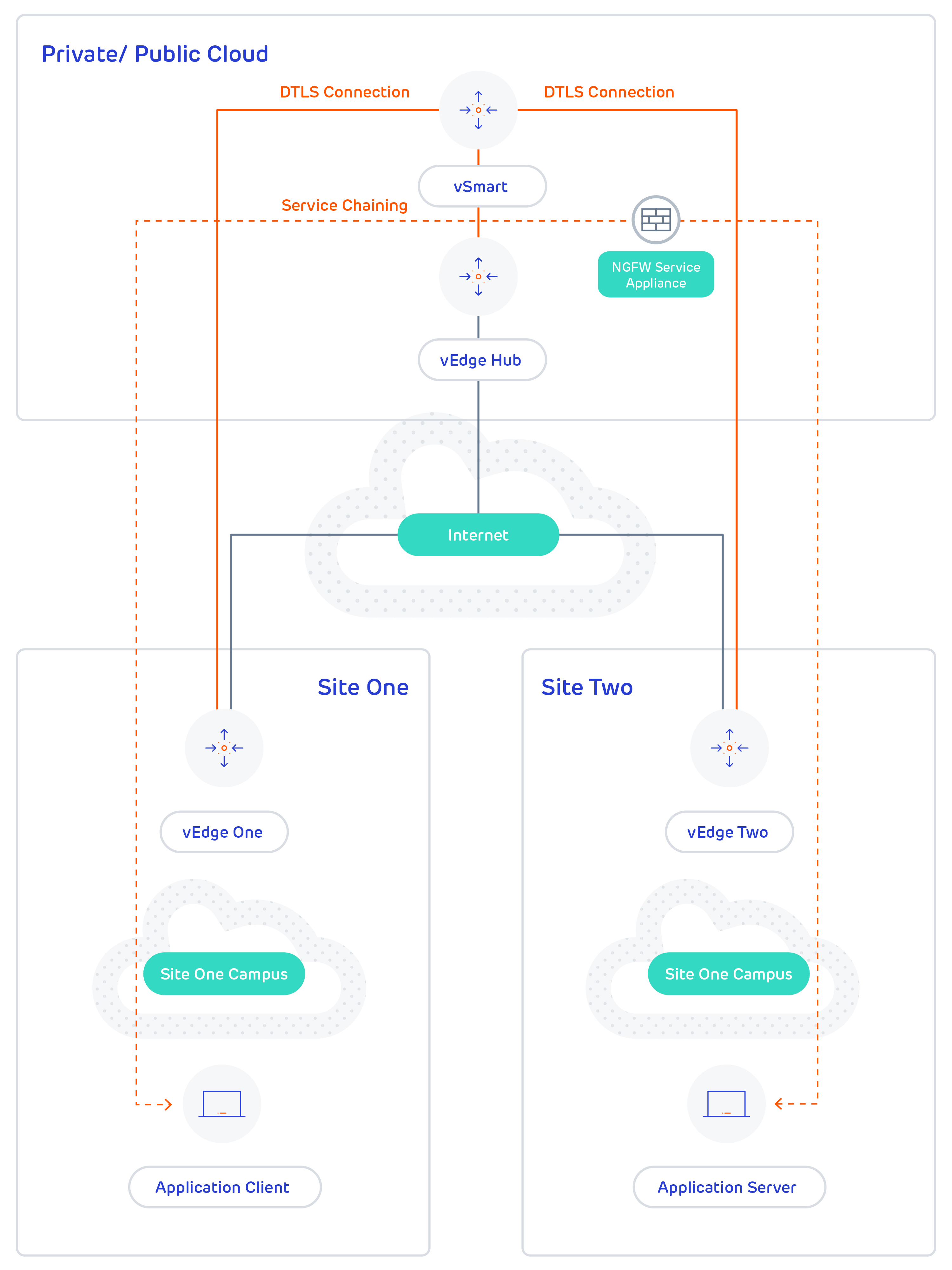
Figure 1. illustrates how service chaining works in the SD-WAN solution. The network shown has a centralized vEdge hub router that is connected to two branches, each with a vEdge router. The standard network design implements a control policy such that all traffic from branch site one to branch site two travels through the vEdge hub router. Sitting behind the hub router is a firewall device. So now, assume we want all traffic from site one to site two to first be processed by the firewall. Traffic from the vEdge router at site one still flows to the vEdge hub router, but instead of sending it directly to site two, the hub router redirects the traffic to the firewall device. When the firewall completes its processing, it returns all cleared traffic to the hub, which then passes it along to the vEdge router at site two.
Book your free one-to-one
Compare SDN to traditional networks to discover whether it's right for your business with our Cisco Certified Internetwork Expert, Adrian Skinner.

